Projects


Insights 03.23.2026
Building on Purpose: Senior Living
Building at GLY goes beyond construction—it’s about people, purpose, and creating spaces where communities truly live and thrive.


Demetrios Stamatakis
Luke McArthur


In Part 1 of our From Vulnerable to Viable: Retrofitting Seattle’s URMs series, we focused on Ensuring Safety + Preserving Heritage—highlighting the physical characteristics of unreinforced masonry buildings [URMs], the roles they play in our community, and why retrofitting them is necessary.
In Part 2, we look at the challenges associated with retrofitting and how community members and government can work together to mitigate these barriers.
The City of Seattle has long studied how to address the public safety of URM structures. While mandating seismic retrofits may seem simple, it's politically complex. Portland's experience shows that legislation alone isn’t enough to motivate action—successful retrofitting requires coordinated support. Before imposing a retrofit mandate, Federal, State, and local governments, along with the community, must provide financial incentives, education, and logistical resources to yield widespread compliance.
The biggest challenge URM owners face is affordability. As discussed in Part 1, owners must navigate not only the costs of engineering, permitting, and constructing the retrofit, but also potential revenue loss during construction. If financing is required, interest payments add another layer of expense.
Retrofitting a URM is highly invasive. Connecting floor joists or beams to masonry walls often requires partial demolition of ceiling and floor finishes, as well as the temporary removal of casework, plumbing fixtures, and mechanical and electrical components. Installing plywood sheathing on floors, roofs, and interior wall framing necessitates further demolition. When braced frames and new foundations are necessary, temporary openings in the exterior envelope may be needed to accommodate heavy materials and equipment. This invasive work, typically lasting months, can render residential URMs uninhabitable during construction.
The temporary loss of housing, much of it relatively affordable, can be highly disruptive. Residents often have to relocate during construction, which is particularly challenging in a region where housing is both scarce and expensive. The situation is more complicated for those URMs that provide supportive housing and services to vulnerable populations, making temporary relocation much more difficult.
To better understand retrofit costs and solutions, let’s consider a hypothetical URM retrofit—see Figure 1. Hypothetical URM Retrofit = $3,694,482. The building in our example is typical of many URMs found in Seattle’s Pioneer Square, SODO, and CID neighborhoods:
While retrofit costs are a major factor, additional expenses—design, permitting, site and building preparation, restoration, and loss of rental income—account for 44% of the total project cost, and shouldn’t be overlooked.


Figure 1. Hypothetical URM Retrofit = $3,694,482. The example building shown above is typical of many structures in Seattle’s Pioneer Square, SODO, and CID neighborhoods. The estimated URM retrofit cost for this building is $3,694,482.
While these barriers are significant, they’re not insurmountable. Statewide and locally, efforts are already in motion to tackle the challenges of retrofitting. Let’s explore what’s being done, and what additional steps are needed, to reduce URM retrofit costs and displacement hardships locally and across the State.
Sales Tax
In Washington, as in most states, sales tax is applied to the total cost of construction. However, unlike most states, Washington does not have a widely applied state income tax. Instead, state and local governments are primarily funded through three major sources: sales tax, property tax, and the B&O tax.
This heavy reliance on sales tax, combined with rising costs across the economy, has resulted in WA state having the fourth highest state and average local sales tax rate in the country. As of March 2026, the City of Seattle’s 10.55% sales tax rate ranks among the highest of all major U.S. cities.
In our hypothetical URM retrofit, the roughly $2.9 million in construction costs would incur an additional $308,482 in sales tax—see Figure 2. Hypothetical URM Retrofit Sales Tax.


Figure 2. Hypothetical URM Retrofit Sales Tax.
Eliminating sales tax on construction costs provides a meaningful reduction in overall project cost. And without sales tax relief, most URM retrofits won’t happen. So, in practice, policymakers wouldn’t be forfeiting revenue by eliminating sales tax on URM retrofit costs. Instead, policymakers would be incentivizing public safety.
Property Tax
Unlike our sales tax, Washington's effective property tax rates are relatively competitive compared to the rest of the country. However, due to high real estate values, property owners in Washington’s major cities end up paying some of the highest property taxes.
To encourage rehabilitation of historic buildings, Washington State offers a program for landmarked properties under RCW 84.26 Special Valuation of Historic Property Act—allowing property owners to deduct approved rehabilitation costs from the assessed property value for 10 years following project completion. Creating a similar law to facilitate retrofitting URMs would reduce cost of ownership for URM owners, helping them repay construction loans and other retrofit costs.
Using our URM scenario, the appraised taxable property value is approximately $2.4 million. Assuming an effective property tax rate of 0.86%, the owner’s annual property tax bill is $20,640.
Upon completion of the retrofit, the owner can deduct the $3,694,482 retrofit cost from the URM’s $2.4 million taxable property value each year for ten years. Since the cost of the retrofit is more than the property value, the property tax bill for the next ten years is $0 for a total savings of $206,400—see Figure 3. Hypothetical URM Retrofit Special Valuation.
These tax incentives, when combined with other means of support, help make URM retrofits feasible. And so, for the past two years, the City of Seattle and countless community members have lobbied the WA legislature to pass House Bill 1810 which would complete the analysis of State-wide financial incentives that reduce the cost burden of life-saving retrofits. Unfortunately, HB 1810 did not advance during the 2026 legislative session, as it was not taken up by the House Appropriations Committee. The final request—$250,000—represented a small fraction of the State’s nearly $78 billion operating budget.
It’s been 25 years since the Nisqually Earthquake shuttered the State’s capitol building and rained bricks onto the sidewalks of Seattle’s Pioneer Square. Rather than reacting to the fallout of our next earthquake, State policymakers should act now to save lives, preserve housing, and limit future recovery costs


Figure 3. Hypothetical URM Retrofit Special Valuation.
Federal Income Tax
Nationally, there’s an existing incentive that income-producing properties listed on the National Register of Historic Places can use to offset qualifying renovation costs, including both soft and hard construction costs. The Federal Historic Rehabilitation Tax Credit allows eligible property owners to claim an income tax credit equal to 20% of the value of rehabilitation expenses.
If our hypothetical URM is on the National Register, the owner could claim a total $738,896 tax refund over a five-year period based on the $3,694,482 in total rehabilitation costs—see Figure 4. Hypothetical URM Retrofit Federal Historic Tax Credit.
Similar national and local tax credit programs exist to incentivize numerous worthwhile undertakings from the development of low-income housing units to making energy-efficient building upgrades. Instead of reacting to disasters and absorbing billions in recovery costs, Washington’s federal legislators must work across party lines to advance tax programs that incentivize strengthening our nation’s existing building stock against earthquakes and other natural disasters.


Figure 4. Hypothetical URM Retrofit Federal Historic Tax Credit.
Zoning Code
Members of Seattle’s preservation and development community are likely familiar with the Transfer of Development Rights program [TDR] for historic landmarks in Downtown neighborhoods and the University District. This program allows owners of landmarked buildings—many of which are URMs—to sell or transfer their unused development potential, often referred to as ‘air rights,’ to developers for roughly $35 per square foot depending on market conditions—see Figure 5. Hypothetical URM Incentive: Transfer Development Rights.
These developers can then apply the purchased square footage to developments within the same neighborhood of the transferring site, allowing them to exceed, within certain limits, the code-prescribed buildable area of the project site.
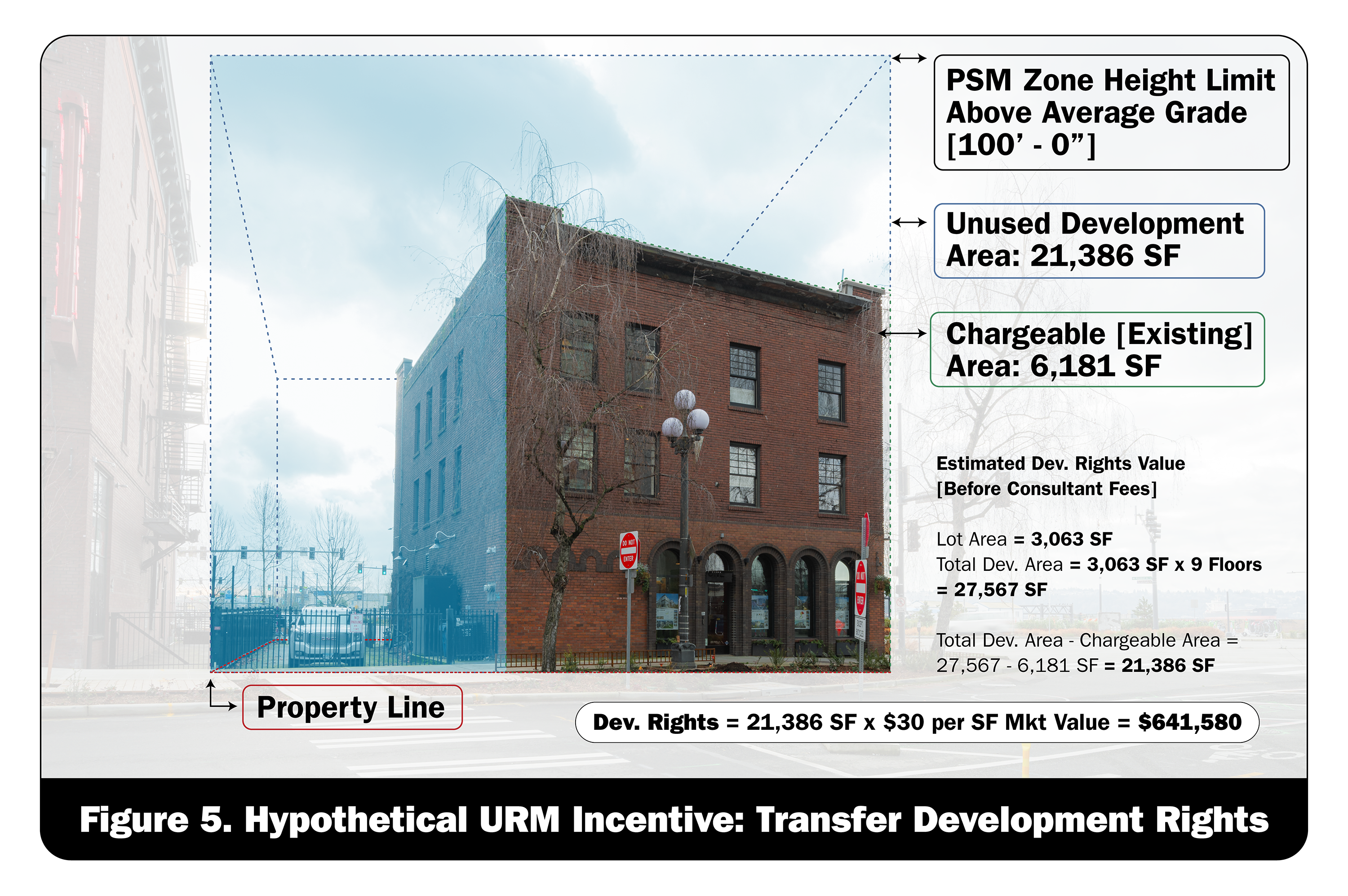

Figure 5. Hypothetical URM Incentive: Transfer Development Rights.
A similar program for URMs, initially proposed by the Alliance for Safety, Affordability, and Preservation [ASAP!], is currently under review at Seattle’s Office of Planning & Community Development [OPCD]. The proposed URM Retrofit Credit would enable URM owners across Seattle to sell the development potential of their site to developers under the condition that proceeds be used to fund retrofit costs. For such a program to be broadly effective, it’s estimated that development rights need to be valued between $60 and $90 per square foot in today’s dollars.
Allowing development rights to transfer citywide would unlock greater demand, increasing the value URM owners can capture. To be effective, however, the program must be carefully managed—balancing supply with demand and ensuring alignment with existing land-use policies.
A more flexible TDR program presents a unique opportunity for Seattle and other Washington cities to address both the life-safety risks posed by URMs and the state’s severe shortage of affordable housing. In recent years, high land and construction costs have constrained new housing development. Expanding the use of URM TDRs citywide would allow developers to distribute costs across more units, improving project feasibility and accelerating delivery. At the same time, URM owners, many of whom operate residential buildings, would gain access to critical funding for seismic retrofits, helping preserve both the structures and the safety of those who occupy them.
Building Code
Seattle’s Department of Construction and Inspections [SDCI] recently collaborated with local design and construction experts to develop the Alternate Method which offers an alternative seismic retrofit pathway to the one originally outlined in Seattle’s Existing Building Code [SEBC]. This new pathway was adopted by the Seattle City Council and went into effect on November 15, 2024.
Retrofitting a URM using this alternative approach is more cost-effective while still meeting minimum life safety standards. Although precise savings are difficult to determine before conducting structural and cost analyses, property owners can generally expect a savings of 20-40% compared to retrofitting under the unamended SEBC.
It's important to note that not all URMs will qualify for Alternate Method due to height, configuration, or other limitations, but many will. In our URM scenario, for example, the building may not be a good candidate for the Alternate Method due to its underlying soil conditions. For more details, refer to Section A603 of the SEBC which outlines the Alternate Method Qualification Criteria.
Lastly, while this retrofit alternative is designed to prevent a URM from collapsing during a major earthquake, it may not prevent significant damage that could result in repair costs exceeding the building's replacement value. In the third and final installment in this series, Part 3: Getting Started, Brick by Brick, we’ll explore how to evaluate your retrofitting options and make informed decisions between the Alternate Method and more comprehensive retrofits.
State and local incentives for our hypothetical URM retrofit are calculated in Figure 6. Hypothetical URM Retrofit – Total Potential Incentive. Total potential savings are $1,895,358—about 50% of the total $3,694,482 retrofit cost. And with a more flexible TDR program, the total potential savings could be closer to $2.5M—about 68% of the total retrofit cost.


Figure 6. Hypothetical URM Retrofit – Total Potential Incentive.
Many URMs are located in dense urban areas, often occupying their entire site footprint. Lack of undeveloped lot space means building owners must use adjacent rights-of-way for staging materials and equipment during construction. In Seattle and other cities, owners must obtain a street use permit and pay fees to temporarily occupy the sidewalk or nearby road lanes for construction activities.
For example, if a URM located along a minor Seattle arterial requires 2,600 square feet of adjacent sidewalk space to be closed for 12 months to accommodate scaffolding, dumpsters, and hoisting equipment, the owner would need to pay Seattle’s Department of Transportation [SDOT] a use fee of $70,512 on top of building permit fees.
Requiring an owner to retrofit their building while also charging permit fees is counterproductive. To support owners and promote public safety, cities across Washington should consider waiving development fees for seismic retrofit projects.
Seattle has already taken an important step by reducing construction permit fees by 50% for projects that contribute to the seismic upgrade of a URM building. Other jurisdictions should do the same, or go even further, to ensure that life-saving retrofits are not hindered by avoidable regulatory costs.
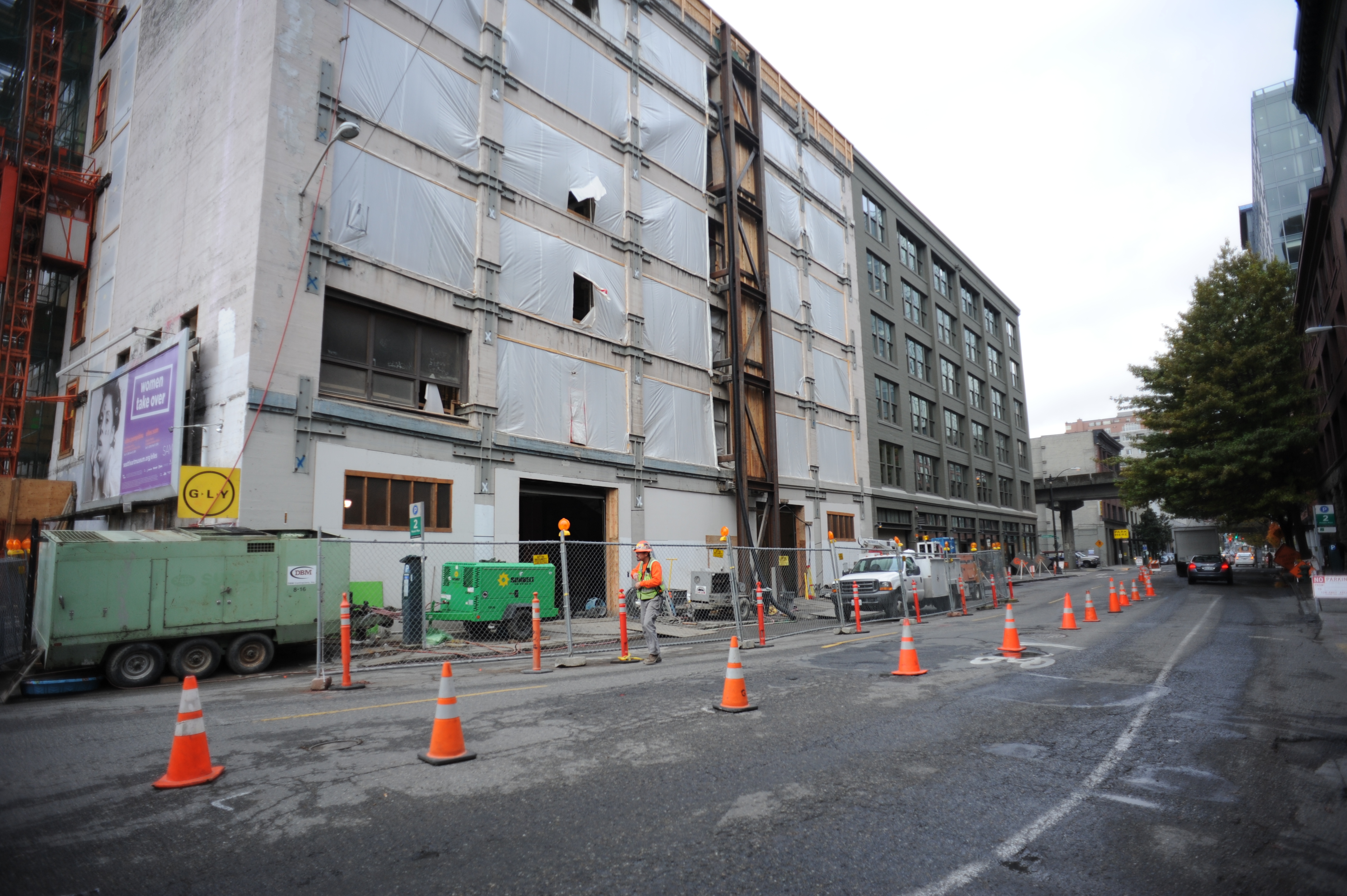

The constrained Western Avenue Building site in Pioneer Square required partial closure of the immediate sidewalk for scaffolding, dumpsters, and hoisting equipment as GLY completed extensive seismic improvements.
To implement a seismic retrofit, URM owners in Seattle must obtain a building permit and other related approvals from Seattle’s Department of Construction and Inspections [SDCI]. Historically, even for relatively straightforward projects, permit review times can range from several months to over a year, making the construction process more costly and unpredictable. To its credit, SDCI has recently implemented permit prioritization for URM retrofit projects and now provides free coaching for building owners to ensure applications are complete and that the proposed work will yield a ‘retrofitted’ status in the City’s URM database.
Other cities should follow Seattle’s lead by expediting permit approvals for URM retrofits and offering complimentary coaching to help reduce the administrative burden facing URM owners and underscore their commitment to public service and life safety.
Local governments should also help address the logistical challenges owners and residents will face during the retrofit. Residents and businesses may need to relocate temporarily, and neighbors will experience the usual noise and traffic disruptions of construction.


[L-R]: Reinforcement work at the Terry Avenue Building and Western Avenue Building shows how invasive seismic retrofits can be. In cases like these—requiring major foundation and superstructure upgrades—tenants must relocate temporarily.
Education, communication, planning time, and financial support are essential to easing the strain of an invasive construction project. Seattle has made progress on this front by establishing a dedicated URM department, which over the past two years has informed and engaged the public through its URM website, webinars, and media outreach.
Community members are also acting. ASAP!, a diverse coalition of URM stakeholders, has raised awareness of the risks posed by unreinforced masonry buildings and proposed solutions to address them. The technical committee that developed the Alternate Method—composed of local engineers who volunteered their time—created a more affordable retrofit pathway that owners are already using.
Still, more work remains:
Educate + engage: City staff and building industry professionals should collaborate to develop case studies, host workshops, and use media channels to further educate URM owners and residents about retrofit importance, process, and available resources.
Support residents: Local and state governments should offer relocation assistance to help residents offset the cost of temporarily relocating during construction.
Improve financing: Government should work with lenders to establish low-cost loan programs for retrofits that give borrowers favorable rates and extended terms while offering lenders tax incentives and government-backed guarantees in return.
Widespread retrofit of Seattle’s URMs will take commitment, coordination, and investment—but it can be done. Cities like San Francisco and others in the Bay Area have already proven that with clear policies, financial support, and community buy-in, the majority of a city’s URMs can be successfully retrofitted.
Seattle has overcome challenges before. After the Great Fire of 1889, we rebuilt Pioneer Square as a fire-resistant neighborhood that still stands more than 130 years later. We transformed contaminated industrial sites into vibrant parks like Gas Works and the Olympic Sculpture Park. And we reconnected downtown to its waterfront by replacing the Alaskan Way Viaduct with a tunnel once thought impossible.
Now, it’s time for Seattle to apply that same determination and ingenuity to safeguard our most vulnerable buildings. By working together we can improve public safety, preserve affordable housing, and extend the life of irreplaceable buildings throughout our City and State. #FixTheBricks


Pioneer Square after Seattle’s Great Fire, June 6, 1889. Public Domain Media: Seattle Photographs Collection.


Pioneer Square present day.
In our final post in this series, Part 3: Getting Started, Brick by Brick, we’ll explore the steps contractors, architects, engineers, and building owners should take to make each retrofit viable and successful.

